


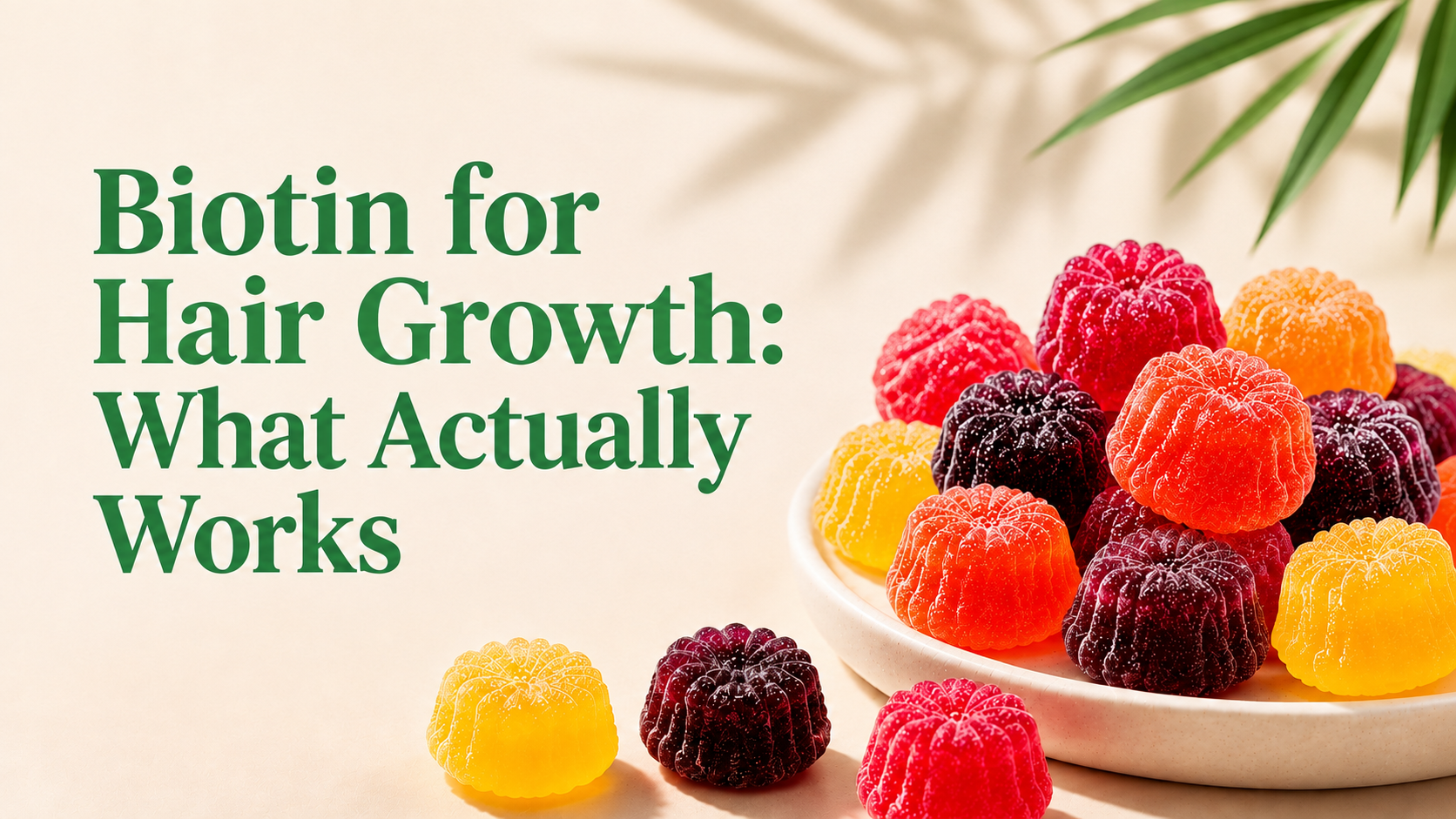
Biotin for Hair Growth: What Actually Works
Hair fall has a funny way of making us notice every strand. A little extra hair on the pillow, a wider-looking parting, or a few more strands in the shower can quickly send us searching for answers. And somewhere along the way, biotin usually enters the conversation. Biotin has become almost synonymous with hair health. It is added to shampoos, serums, supplements and, increasingly, gummies. The promise sounds simple: take biotin, strengthen your hair and encourage growth.
But is it really that straightforward?
Not quite.
Biotin does have an important role in the body, but the idea that taking more of it automatically means growing thicker, longer hair is not strongly supported by science. Understanding where biotin actually helps, and where the hype begins is the better way to approach hair wellness.
What is biotin, exactly?
Biotin, also known as vitamin B7, is a water-soluble B vitamin. Your body uses it to help process carbohydrates, fats and proteins and turn them into energy. It is also involved in processes that support healthy skin, hair and nails.
You can naturally get biotin from foods such as eggs, fish, nuts, seeds, meat and some vegetables. For most healthy people eating a varied diet, getting enough biotin isn’t usually difficult. In fact, biotin deficiency is considered rare.
So why did biotin become such a popular hair-growth ingredient?
The connection comes partly from what happens when the body doesn’t get enough of it. Biotin deficiency can cause symptoms including thinning hair and hair loss. That led to a very understandable assumption: if too little biotin can contribute to hair loss, perhaps taking extra biotin can make hair grow faster. The science, however, isn’t quite that simple.
Does biotin actually make hair grow?
Here’s where the popular hair-care advice needs a little context.
There is limited evidence that biotin supplements improve hair growth in people who already get enough biotin. A 2024 review of available studies found only a small number of relevant clinical studies, and the higher-quality evidence did not show a clear benefit for hair growth in otherwise healthy individuals.
The National Institutes of Health also notes that there is little scientific evidence supporting the common claims that biotin supplements improve hair, skin and nails.
That doesn’t mean biotin is useless.
It means more isn’t automatically better.
If someone has a genuine biotin deficiency, correcting that deficiency can help address associated symptoms, including hair loss. But taking large amounts of biotin when you already have adequate levels doesn’t necessarily give your hair an extra growth boost.
Think of it like watering a plant. If the plant needs water, giving it enough can make a real difference. Pouring several extra buckets on it won’t necessarily make it grow faster.
So, what actually affects hair growth?
Hair growth is influenced by much more than one vitamin. Your genes, hormones, age, stress levels, overall nutrition and health can all play a role. Hair loss can also have many different causes, including nutritional deficiencies, thyroid problems, hormonal changes, certain medications, illness and genetic hair-loss conditions. That’s why simply reaching for a biotin supplement may not address the real reason behind hair fall.
Nutrition matters, though.
Your hair needs adequate protein and a range of nutrients to support its normal growth cycle. Iron, zinc, vitamin D, vitamin B12 and other nutrients may be relevant in particular situations, especially when a deficiency is present. This is why identifying the underlying issue is more useful than treating every case of hair fall as a biotin problem. If hair loss is sudden, persistent or noticeably increasing, speaking to a dermatologist can help identify what is actually going on.
Where does a biotin supplement fit in?
This is where supplements can have a role, but with realistic expectations. A well-formulated supplement can help fill nutritional gaps when your diet or individual needs make that necessary. But it shouldn’t be treated as a magic solution for hair growth. For people looking for a more convenient way to include targeted nutrients in their routine, formats such as gummies have also made supplementation easier to incorporate into everyday life.
The Core Company, for example, offers Hair, Skin & Nails Gummies as part of its wellness range, bringing nutrients associated with everyday beauty and wellness into a convenient, enjoyable format. The important part is understanding what a supplement can realistically do. It can support your nutritional intake. It cannot replace a balanced diet, adequate protein, proper hair care or professional advice when there is an underlying medical concern.
Don’t fall for the “more biotin, more hair” idea.
One of the biggest misconceptions around biotin is that taking a very high dose will produce faster results. There isn’t strong evidence for that in people who aren’t deficient. And there is another reason not to go overboard: high-dose biotin can interfere with certain laboratory tests, including some tests used to measure thyroid hormones and other important health markers. That means it is worth telling your doctor or healthcare professional if you’re taking a high-dose biotin supplement before having blood tests.
More importantly, loading up on one nutrient can distract from the bigger picture.
Healthy hair needs more than biotin.
It needs overall nourishment, consistency, and attention to the reason behind the hair problem.
The bottom line
So, is biotin good for hair?
Yes, but not in the way the internet sometimes makes it sound.
Biotin is an essential nutrient, and a deficiency can contribute to hair loss. But for someone who already gets enough biotin, there isn’t strong evidence that taking extra amounts will suddenly make hair grow faster or thicker.
What actually works is a more balanced approach:
Eat a varied, nutrient-rich diet with adequate protein.
Address confirmed nutritional deficiencies rather than guessing.
Pay attention to persistent or unusual hair loss.
Choose supplements based on your actual nutritional needs.
Give your hair routine time and consistency.
Speak to a dermatologist if hair loss continues or becomes significant.
Biotin can be part of the conversation about healthy hair, but it shouldn’t be the whole conversation. Because when it comes to hair growth, there is rarely one magic ingredient hiding in a bottle.